Chinese
 English
 français
 Deutsch
 italiano
 español
 português
 日本語
 한국의




- Huis
- >
Categorieën
Hete producten
Patent CN215656472U - Sorter with Anti-Clogging Feeder
Oct 27,2026Finished cylindrical cells are fed jam-free through anti-clogging plates and a wheel-type filler, graded by internal resistance, then pushed by air cylinders into the right grade bin.
Full specification and drawings: CN215656472U on Google Patents
When cylindrical batteries leave the production line they have to be sorted into quality grades and collected separately. The specification of CN215656472U is blunt about the failure of the conventional way: sorting easily suffered from battery clogging, which pushed up the sorting reject rate. If the feeding stage jams, nothing downstream can be graded correctly.
The patent answers at the point where clogging happens - the feed. Two anti-clogging plates and a motor-driven wheel-type filler turn a simple hopper into a controlled, jam-free feeder, an internal-resistance detector grades each cell before it enters the conveyor, and four air cylinders route every cell to the bin of its grade.
Patent Information
| Publication number | CN215656472U |
| Application number | CN202122170781.7U |
| Title (original) | 一种带有防堵装置的电池分选机 (Battery Sorting Machine with Anti-Clogging Feeder) |
| Inventors | Huang Zhengyao (Dany Huang); Chen Lucai (Tobey Chen) |
| Current assignee | XIAMEN TOB NEW ENERGY TECHNOLOGY Co., Ltd. - the registered entity of TOB NEW ENERGY |
| Filing date | 9 September 2021 |
| Grant date | 28 January 2022 |
| Document type | Utility model (kind code U) |
| Legal status | Active |
| Anticipated expiration | 9 September 2031 |
| Drawings | 6 figures |
| Official record | CN215656472U on Google Patents |
The Production Problem This Patent Solves
Feeding jams break a sorting line. Processed cylindrical cells must be sorted into different quality grades and collected and stored grade by grade. In conventional sorting the cells jam at the feeding stage, and the specification states that this raises the sorting reject rate. A sorter that cannot feed reliably cannot grade reliably.
Grading must happen before routing. To put each cell into the right bin the machine has to know something about the cell first. This design measures internal resistance as the cell passes from the feeder onto the conveyor, and only then decides which bin the cell belongs to.
How to sort batteries without clogging - to raise production efficiency and the qualification rate - is the technical problem the patent sets out to solve.
How the Mechanism Works
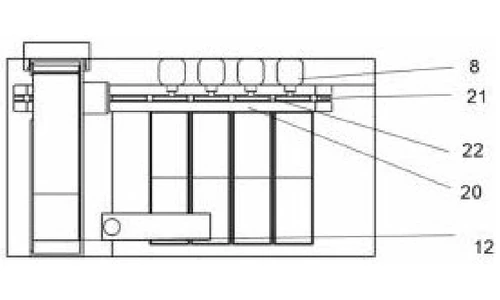
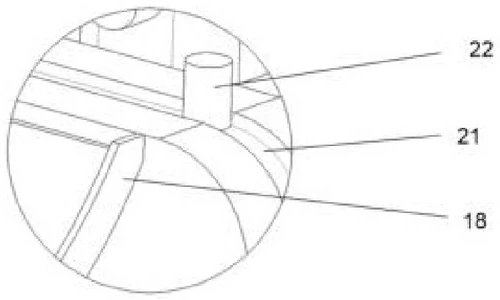
The machine is arranged around a main body on four base feet, with the anti-clogging feeder on the left, the grading and conveying line across the middle, and the storage bins above. Figures 1-5 give the structural, side, rear, isometric and top views; Figure 6 enlarges detail A.
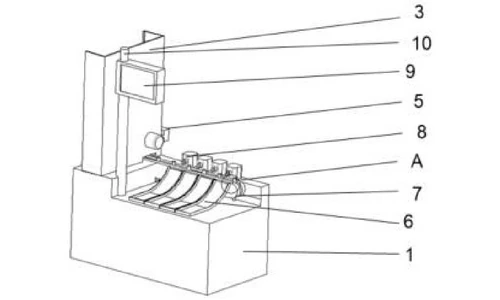
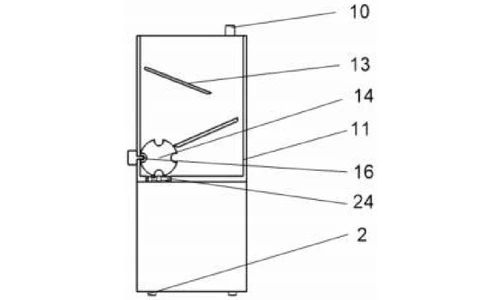
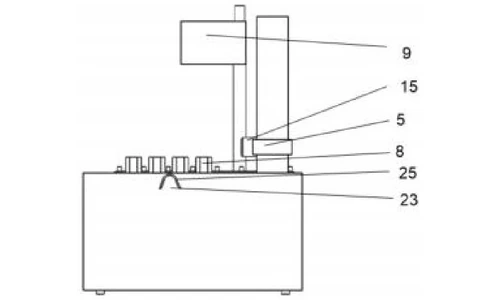
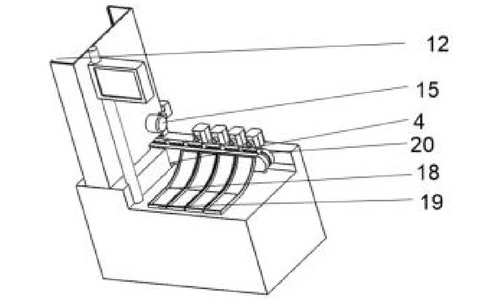
Anti-clogging feeding hopper
The anti-clogging hopper is screwed to the left part of the main body, with a first groove in the body below it. Its left wall is transparent glass so the operator can watch the feed. The feeding hole on top leads down to two anti-clogging plates, screw-fixed in the hopper, that break up cell build-ups. Beneath the plates sits the wheel-type filler, whose centre shaft is concentric with a first motor mounted outside the hopper. The filler meters the cells one by one toward a first through-hole at the bottom of the hopper - the specification attributes the prevention of battery clogging to this combination of two anti-clogging plates and the wheel-type filler.
Internal-resistance grading at the transfer point
An internal-resistance detector on the rear side of the hopper carries an internal-resistance probe aligned concentrically with the hopper through-hole. As each cell leaves the feeder and before it is loaded onto the transport device, the probe measures its internal resistance. The result is classified and stored by the controller, which sits on the fixing rod of the main body with an indicator lamp on top.
Conveying, spacing and binning
The transport device has a bracket screw-fixed to the main body and a semi-elliptical belt in the middle of the bracket. Partition plates pass through the belt and are fixed to the bracket, holding the cells apart as they travel. The bracket is driven by a second motor housed in the third through-hole of the main body. On the rear side of the transport device stand four air cylinders: as the belt carries each cell past the storage area, the cylinder of the matching grade pushes the cell into the corresponding battery storage device, whose tail is level with the transport height. Each storage device has a fixed baffle on its side and a detachable front baffle, so a full bin of sorted cells can be opened and emptied easily.
Working sequence as published: parameters are set on the controller; cells are poured into the anti-clogging hopper; the cells pass the anti-clogging plates and enter the wheel-type filler; before loading onto the transport device the internal-resistance detector measures and classifies each cell and stores the class in the controller; as the belt transports the cells, the four air cylinders push each cell into the storage device of its measured internal-resistance class.
Claimed Benefits
| Benefit | Mechanism responsible |
|---|---|
| No battery clogging during feeding | Two anti-clogging plates combined with the wheel-type filler metering cells through the first through-hole |
| Automatic grading before routing | Internal-resistance probe aligned with the hopper through-hole, results stored by the controller |
| Orderly transport and correct binning | Semi-elliptical belt with partition plates, driven by the second motor; four air cylinders route cells by class |
| Easy removal of sorted cells | Battery storage devices with fixed side baffle and detachable front baffle |
How It Compares with Conventional Cell-Sorting Feeders
In conventional sorting, cells jam at the feeding stage, and the specification states that this raises the sorting reject rate. A sorter that cannot feed reliably cannot grade reliably - so this patent starts with the feed.
| Dimension | Conventional approach | This patent design |
|---|---|---|
| Feeding | Cells jam at the hopper, raising the reject rate | Two anti-clogging plates with a wheel-type filler meter cells through the hopper |
| Grading | Grading decisions made off the feed line | Internal-resistance probe aligned with the hopper through-hole grades before routing |
| Binning | Jumbled transport and manual binning | Partitioned belt conveys cells in order; air cylinders push each grade into its bin |
Where This Technology Is Used Today
CN215656472U covers the anti-clogging feeding and internal-resistance grading architecture of TOB's battery sorting equipment - the station where finished cylindrical cells are separated into quality grades before packing or further processing.
- Battery sorting and grading machines - equipment for sorting cylindrical cells by test results
- Battery testing systems - testing equipment used before grading and routing
Related equipment enquiries: request a quote
Frequently Asked Questions
What does patent CN215656472U cover?
It covers a battery sorting machine with an anti-clogging feeder. Finished cylindrical cells are poured into a screw-mounted hopper with two anti-clogging plates and a motor-driven wheel-type filler, each cell is graded by an internal-resistance detector before it enters the transport device, and four air cylinders push the cells into the battery storage device of the matching grade.
Is this patent about battery separators?
No. The Chinese original title is a battery sorting machine, and the device sorts finished cylindrical cells by internal resistance. The word "separator" appears only because the machine-translated record on Google Patents mistranslates the Chinese word for sorter; this patent has nothing to do with separator films.
How does the feeder prevent batteries from clogging?
Two anti-clogging plates are fixed below the feeding hole, and beneath them a wheel-type filler is driven by a first motor whose shaft is concentric with the filler centre axis. The plates break up cell build-ups and the filler meters the cells one by one toward the first through-hole, so the feed does not jam.
How are the batteries graded?
An internal-resistance detector behind the hopper has a probe aligned concentrically with the hopper through-hole. As each cell passes the transfer point and before it is loaded onto the transport device, the probe measures its internal resistance, and the controller classifies and stores the result.
How does the machine route cells to the right bin?
The transport bracket is screw-fixed to the main body and carries a semi-elliptical belt with partition plates fixed to the bracket that keep cells spaced. A second motor in a through-hole of the main body drives the belt, and four air cylinders on the rear side push each cell into the storage device of its stored class; each storage device has a detachable front baffle for easy emptying.
Is patent CN215656472U still in force?
Yes. It is Active, filed on 9 September 2021 with anticipated expiration on 9 September 2031.
Full specification and drawings: CN215656472U on Google Patents
 Abonneer u op ons